CN

loading
SmartPerfetto Is Open Source: A Perfetto AI Assistant for Android Trace Analysis

SmartPerfetto is now fully open source. Open the repository and you can see the runnable mainline project as it exists today: the Perfetto UI fork, the agentv3 backend, MCP tools, YAML Skills, scene strategies, scripts, and documentation. There is no private core module kept outside the repository, and this is not just a thin demo shell.

The project comes from a very concrete daily workflow: you have a trace in hand, Perfetto has already exposed the facts, but moving from facts to judgment still means jumping through tables, writing SQL, matching threads, checking FrameTimeline, finding the Binder peer, and then returning to the timeline to confirm everything again. SmartPerfetto tries to turn those repeated actions into tools, so performance engineers can spend more time on judgment.

It is still in development. I am releasing it now because trace analysis grows from real samples: real devices, real vendor differences, real product traces, and real PRs all change how Skills and strategies should be written. Waiting until every capability is stable before publishing it one way would miss the stage where samples matter most.

If you often open Perfetto to inspect scrolling jank, startup, ANR, Binder, CPU scheduling, or rendering pipelines, SmartPerfetto provides a Perfetto UI with an AI Assistant. After loading a trace, you ask questions in natural language. The backend queries trace_processor_shell, invokes YAML Skills, organizes evidence, and streams conclusions plus data tables back into the browser.

Project links:

For normal trial use, you only need the main repository. Gracker/perfetto is the frontend fork used by the perfetto/ submodule. It mainly matters to developers who want to modify the AI Assistant plugin UI.

The previous two technical articles are better for readers who want the engineering details:

Those two articles go deep into the internal architecture. Once the source is public, readers usually care more about what is actually in the repository, whether it can run, and which parts are not stable yet. This article focuses on the open-source release itself: what is open, what works today, how the internal pieces are divided, how to run it locally, and where collaboration is most useful.
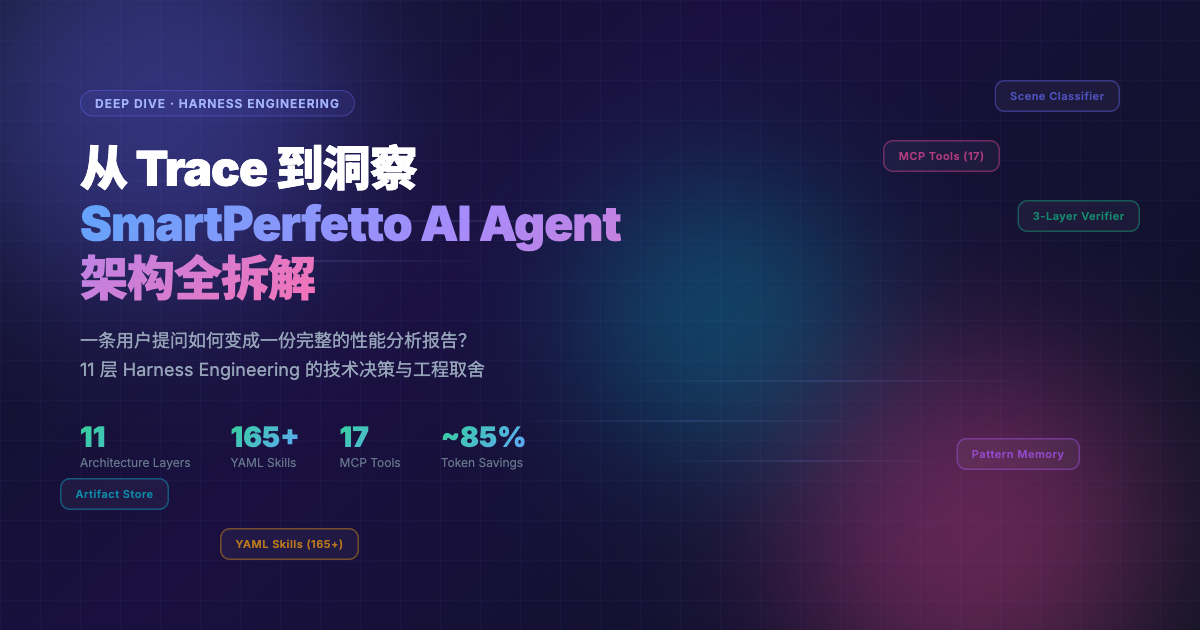
Long-form Forecast: Phones May No Longer Start from Apps: How Agent OS Takes Over the Task Entry Point

Starting from Ming-Chi Kuo’s April 27, 2026 supply-chain report about an OpenAI phone, this article looks at the possible system shape after phones and AI merge, from the perspective of someone who works on Android phones.

Introduction: This Is Not Just a New Phone Problem

The most interesting part of Kuo’s report is not the 2028 mass-production window. It is not whether MediaTek, Qualcomm, or Luxshare ends up in which supplier position either.

It pushes the question into the system layer:

If the user’s primary goal shifts from opening apps to completing tasks, what should a phone operating system look like?

That sounds like a UI question. From an Android practitioner’s perspective, it touches the whole system structure: Launcher, notifications, permissions, IPC, app capability declarations, model runtime, TEE, device-cloud sync, task state machines, audit logs, payment confirmation, and developer revenue sharing all need to be reconsidered.

Over the past few years, most discussions about AI phones have stayed at the feature layer. Vendors talk about AI photo editing, AI erase, AI summaries, AI search, AI assistants, and AI briefings. All of these can fit inside today’s Android or iOS architecture.

If OpenAI really builds an AI Agent phone, it will move the question from “how many AI features can be added to a phone” to “should the phone’s first entry point still start from app icons?”

The main line is this: Agent OS looks like a structural migration of mobile OS after the graphical interface era. The foreground moves from an app grid to a task stream. The background moves from app-owned capability to authorized capability. The system moves from managing processes and windows to managing tasks, context, and responsibility.

OpenAI does not have to build on Android, but Android is the more likely path because it inherits hardware adaptation, drivers, app compatibility, and supply-chain experience. If OpenAI wants to design the first screen, permissions, and task flow completely around Agent OS, it may also choose an “Android-compatible but not quite Android” path, or even build a Linux-based system and fill the service gap with the web, cloud execution, and an app compatibility layer.

Different OS choices will change go-to-market speed. They will not change the five things Agent OS must solve:

  1. The phone must continuously understand the user’s current state.
  2. Apps must move from foreground entry points to background capability providers.
  3. The system must have a task runtime that is recoverable, cancellable, and auditable.
  4. Device-side and cloud-side execution must be split by data sensitivity and real-time needs.
  5. Every cross-app, cross-device, and cross-cloud action must have permission, responsibility, and rollback boundaries.

Without these five things, an AI phone is still just “a phone with an AI assistant.” Once they become system constraints, the phone starts moving toward Agent OS.